
Townhomes emerge as solution for aging suburban office parks
Nov 7, 2025
Picture this landscape. You’re driving to the office. It’s way out there, pretty deep in the suburbs off a nondescript highway that’s seemingly backed up at all hours. After navigating the inevitable morning rush, you pull into your parking lot. There’s so much surface parking, because Metro isn’t anywhere close by. Your midrise office was constructed in 1983 and looks like it. Maybe it was renovated in 2005. Still, that was a generation ago.
Your options for coffee, breakfast and lunch are, if you’re lucky, the independently owned deli-cafe combo on the ground floor. More likely, you’re driving again. At least the parking is free. Your office window offers a view of a half-empty lot, or maybe a second, twin office built around the same time because that was the trend. You’re driving to happy hour. You’re driving home.
Employees don’t enjoy this. This is why suburban office parks are dying.
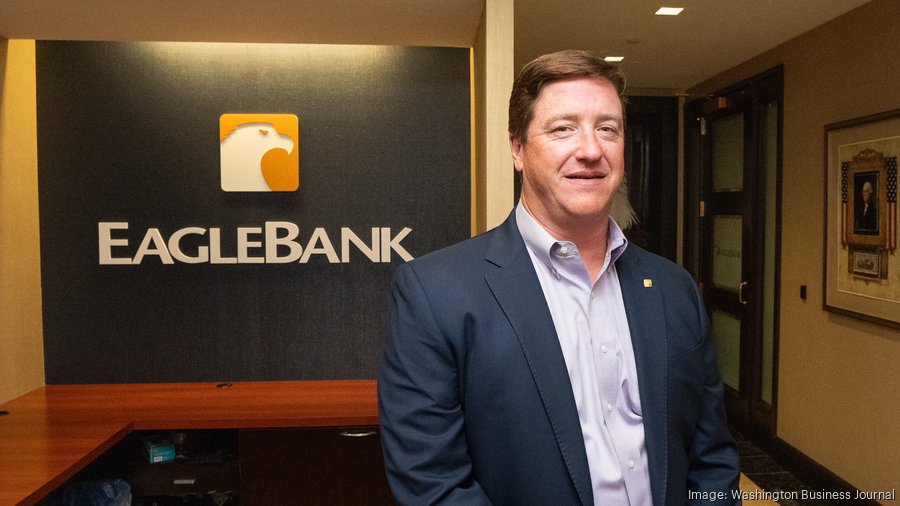
It all comes down to the highest-and-best use question, said Ryan Riel, chief real estate lending officer at Bethesda-based Eagle Bancorp Inc.
“It was an office building for the last 20 years, and maybe that worked, maybe it didn’t,” he told me. “But it certainly doesn’t work looking forward.”
Enter the townhouse.
That’s the answer, at least in part, to the question of what might become of Greater Washington’s vast collection of obsolete suburban office, at least for certain office parks in the region’s vast spaces beyond central business districts. There are dozens of projects currently underway in Greater Washington.
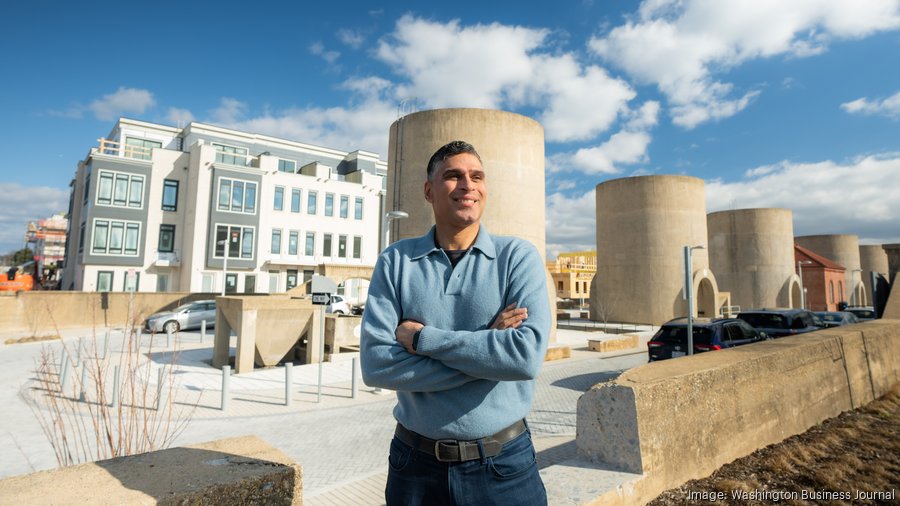
They’re just a “great use” with a lot of versatility, Aakash Thakkar, EYA LLC’s chief acquisitions officer, told me. His firm’s been redeveloping suburban office parks with that use for a decade — to the tune of more than 3,000 units — even before Covid accelerated the “flight to quality” impulse that’s left many aging suburban parks decisively in the dust and ripe for reinvention.
In fact, EYA is behind two of the largest such redevelopments we’re tracking — the largely vacant Lake Fairfax Business Park in Reston and AT&T Inc.’s aging regional office campus in Oakton, with more than 1,400 units combined, about half of them townhouses, accounting for the majority of the land area.
Industry insiders tell me townhouses are attractive for three main reasons. First, basic supply and demand: lots of people want that kind of for-sale product right now, and so prices are signaling to developers to build more of it. Second, it’s a product developers can consistently finance in this current climate. And third, townhouses are a good way to achieve an appropriate level of residential density and so-called “placemaking” in suburban areas that aren’t well suited for super-dense apartment towers and mixed uses.
Give the people what they want
Everyone I spoke to pointed to the simple fact that townhouses are attractive to a wide variety of people who want to own a home, but there aren’t enough of them.
“There’s a huge demand for for-sale products. People in this region, to the extent that they can find housing that is attainably priced and works for them, want to be homeowners,” Thakkar said, noting demand has outstripped supply because so much of the region is zoned as single-family.
Riel recounted his own story of wanting to buy a home when he and his wife moved to the region in 2006, but “very quickly” learning that a townhouse was the way to go, “because we couldn’t afford anything else, right?”
Townhomes fit into what many planners and housing experts have long dubbed the “missing middle,” meaning housing types that provide an intermediate step between renting an apartment and owning a single-family detached suburban home. A lot of folks — a youngish couple with a kid, say — can afford more than the former, but get stuck there, because they can’t afford the latter, and there are too few options in between.
Townhouses are good for “both move-ups and move-downs,” as Antonio Calabrese, managing partner of DLA Piper’s Northern Virginia office, which has handled several suburban office redevelopments, told me in an interview.
“You’ve got young professionals who aren’t ready to, or can’t afford, a single-family detached home or want to be in a more urban environment than a single-family detached home,” Calabrese said.
But much demand is also driven by retiring couples who want to downsize. “Their kids aren’t there anymore; they don’t really need or want much yard work; they like having their own home.”
Different types of townhouses meet a relatively broad diversity of desires within the overall demand. Bailey Edelson, a Buchanan Partners LLC principal, pointed to Parkline at Woodland Park, the name of an office redevelopment with hundreds of townhouses that Buchanan and The Pinkard Group LLC are pursuing in Herndon. The project will offer traditional townhouses that are 16-, 20- and 22-feet wide, plus two-over-twos with a bigger upper unit and smaller lower unit.
“So you have five product types and five price points,” Edelson said, which not only helps satisfy a diversity of demand, but also “allows you to sell a product at a faster pace.”
Dollars and sense
It’s not difficult to understand that residential is generally a more in-demand use these days than surface-parked suburban office campuses way past their prime. But why build 100 townhouses on site where 300 apartments could conceivably go?
The calculus is a complex function involving a host of variables, including a property’s basis, construction costs, interest rates, etc., with every property and project being unique. But in general, for townhouses, “those dynamics have moved in a positive direction, while the dynamics in the multifamily market have moved in a negative direction,” Edelson summarized.
Townhouses simply offer a “better return” at the moment, while multifamily is often “not financeable from a debt or equity standpoint,” said Doug Firstenberg, a principal at Bethesda developer Stonebridge.
His firm is in the process of reinventing Alexandria’s Victory Center, a big, long-vacant office property at 5001 Eisenhower Ave., with residential uses, including a multifamily conversion of the office itself, and townhouses and some additional multifamily on the surface parking lots. Stonebridge already sold the eastern parking lot in 2021, where Tri Pointe is now selling brand-new townhouses from the low $700,000s.
For any project, a developer has to go out into the world of money to convince investors and lenders that a given project will provide an attractive return compared to alternative ways they might put their money to work, with the ultimate floor being the functionally risk-free 10-year Treasury yield. In real estate, that return comes either from apartment rents or proceeds from the sales of houses or condos, net of costs. That ROI math simply works out better at the moment for townhouses in many cases.
“A lot of it is construction costs,” which for multifamily have outpaced rents, Edelson said. Construction costs have gone up for townhouses, too, “but not in the same proportion,” and in any case, “there’s such a lack of single-family or for-sale home supply that prices have risen like crazy since Covid.”
Riel said multifamily cash flows are more pinched these days with insurance costs, real estate taxes and operating expenses increasing.
“That’s the issue, rents are still going up in our area, generally, but they’re just going up by less than the expenses are going up, therefore the net operating income is less,” Riel explained. “That’s the number that pays the debt, that pays investors, that provides the return. So the less that is, the less likely the highest and best use is in multifamily.”
Also relevant to the question of economic calculus is that townhouses are a simpler project — no elevators, no parking structures, no complex ventilation systems, no ongoing operating expenses, no need to replace construction financing with permanent financing, etc. — that deliver faster. That speed enhances certainty, because financial assumptions undergirding your project are more likely to remain true over a nearer time horizon than a longer time horizon.
“You build a stick of six to 10 townhouses at a time, you don’t go spend two years delivering 250 units” more-or-less all at once in an apartment building, and maybe many more years delivering subsequent multifamily phases, if it’s a multibuilding project, Edelson said. With townhouses, “you can recycle your capital” in quicker iterations, with land development taking perhaps six to nine months, and then sticks, or discrete clusters of attached homes, delivering every three to six months thereafter, she said.
“Essentially, you’re selling along the way, you don’t get to the end and realize, oh shoot, I’m in a terrible market, now my rents aren’t what I thought they were [going to be],’” Edelson said.
Context matters
Townhouses are well-suited for suburban office conversions because those locations are — well — suburban.
In urban centers, multifamily and large-scale mixed uses are more suitable. No one is talking about knocking down an office high-rise to build a dozen townhouses.
As a rule of thumb, Thakkar said a suburban office park on the order of seven or more acres might make townhouses a good fit.
“Even if, let’s say, you could build a wood-frame apartment building, the locations aren’t premium locations for multifamily,” he said. “But they are premium locations for townhouses, because townhouses are — ‘comfortable’ is probably the right word — in more residential, lower- and mid-density neighborhoods, with some amount of retail, but not right on top of the Metro, and not proximate to 50 shops.”
Townhouse buyers still generally like “placemaking,” or the concept of establishing in a development or submarket a sense of unique character or identity, especially vis-a-vis amenities. But placemaking shouldn’t be conflated with massive density and mixed uses right on top of each other, Edelson said.

Too often “it takes on this connotation [that] the only way to place-make is to have these massive developments,” she said. “What placemaking is really trying to get at is, how does it feel like a community where someone actively wants to go and be, but there’s many ways to do that, besides multifamily with ground-floor retail — I want to have a grocery store near me, but I don’t want to live on top of it.”
For example, while Victory Center doesn’t include internal retail, a Wegmans is only about an eight-minute drive away, with other shopping at Cameron Station and the Van Dorn Metro station also nearby.
Sometimes placemaking can be the “big, glitzy” thing, Edelson said, but “some people want just a nice tree-lined street with some interesting architecture, a few places they can walk to and get their groceries, and have a nice park and have a community.”
— Liz Trubeck contributed to this story.